The people · 2026年6月
A Pair of Hands
She sits on the threshold tying flowers, her hands never stopping, her eyes on that small square of sky at the end of the lane.
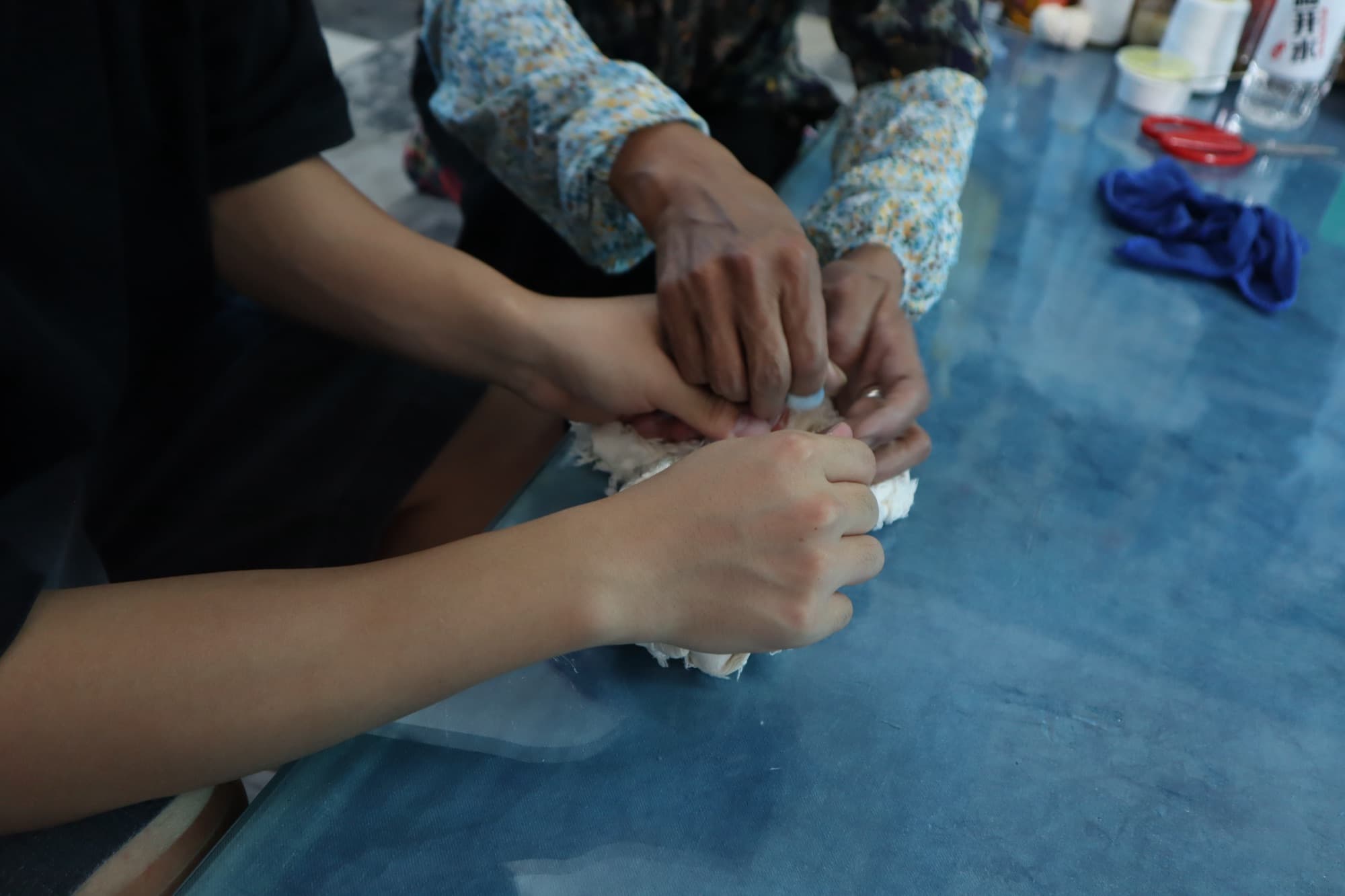
I sat down beside her and watched. A square of white cloth across her knees; her left hand pinches it into a little peak, her right winds the threaded needle around it, three turns, pulled tight, knotted, on to the next. Too fast to follow. A few thousand knots in one cloth, she said. Can't count them, doesn't count them. Dawn to dusk; one cloth done is one cloth done.
How long had she done it. Since she was a girl, and now her hair's white. There'd been a break — a dozen years she didn't touch a needle. She'd gone out to work, into a factory, a sewing machine, running someone else's drawn line where you couldn't be off by a hair. When she came back and took up the needle, her hands had gone badly out of practice; everything that first month was waste. She thought they were finished for good. But she kept on, and one day she couldn't name, the hands remembered.
The hands forget, she said, but not all the way. What's forgotten — don't rush it — comes back on its own.
Was it hard. She didn't answer it straight. The needle goes into your finger all the time; at first it hurts, hurts to the bone, and after enough of it, it stops, it calluses. She held out her hand — the inner side of finger and thumb, a layer of hard yellow callus, so thick the print was nearly gone. Under here, she said, is decades.
The yard was quiet. Not many in the village still tie, she said — all old women. The young won't learn it; too slow, too little money. The machine-printed cloth runs thousands of metres a day, every flower the same, cheap as anything. Who has the patience to tie it stitch by stitch.
She said it evenly, not like a complaint, more like remarking on the weather — something that won't change.
Then why do you still tie. She paused, as if she'd never put the question to herself. It's what I know, she said. Idle is idle either way; the hands want something to do. Then she bent her head and went on, as if the pause had been a thing she didn't need.
Leaving, I looked back. She was still on the threshold, head bent, the light from the doorway falling at a slant across her and the cloth on her knees, the whole of her gone still — like a very old photograph, the colour faded out, only an outline and a pool of light.
That night I kept thinking about those hands, that callus. The roads few people walk — not because no one has seen where they lead, but because they're too hard; you go a few steps and turn back. The ones who walk them to the end mostly start from a pain the rest of us can't reach: worn by living, bound to someone else's drawn line, hurt until it stopped hurting.
But she says none of this. She only sits on her threshold, looking at that small square of sky, stitch by stitch, tying a flower not yet visible — one you'd have to unpick the threads to see how it had opened.
Beneath the illusion: something true, quiet, plain.